
This article is part of an ongoing series exploring the history of the Warren Township School District. Each installment examines a distinct era in the district’s development.
In the mid-1980s, Warren Township Schools were preparing to become smaller. Enrollment had fallen sharply after the boom of the 1950s, 1960s, and early 1970s. Washington Valley School had closed in 1976; Woodland followed in 1982. By 1983, district enrollment had fallen to 911 students, and the Board was considering one more step: closing Central School.
Instead, the township changed.
As Interstate 78 neared completion, Warren anticipated new residents and new housing. The plan to close Central was shelved. In time, the decision not to sell Washington Valley and Woodland—despite pressure to do so—proved one of the district’s most consequential acts of restraint. The buildings that had seemed surplus would soon become essential again.
A Reversal in Fortune
Growth did not return quietly. By 1993, community census data, enrollment projections, and a Planning Advisory Committee were guiding the district’s response. Yet capacity had not been rebuilt, and the Board faced a familiar question: how much should Warren spend before the need was visible to everyone?
Expansion referendums failed in 1988, 1994, and 1995, and the 1994 defeat brought especially sharp disagreement over Board-community relations. The arguments were recognizable from earlier eras: taxes, timing, traffic, operating costs, and whether the district was building too much—or waiting too long.
The first major response was the return of Washington Valley School. Closed during the previous decline, it reopened in September 1991 as Angelo L. Tomaso School, honoring the superintendent who had guided Warren through its earlier postwar expansion. A school built for one generation of growth had been preserved for the next.
Woodland and the Shape of the District
Woodland presented the next—and more complicated—test. Reopening the building required renovation, additional classrooms at Warren Middle School, new attendance zones, staffing, parking and traffic planning, and a decision about grade configuration.
The proposal ultimately approved by voters in October 1996 called for renovating and expanding Woodland as a 325-student K–5 school, along with a three-classroom addition at the Middle School. It passed 1,690 to 1,349.
The decision followed an unusually structured public process. During a series of 1995 planning meetings, the Board and community developed more than sixty objectives and distinguished nonnegotiables from preferences. The plan had to accommodate enrollment through 2002 and preserve current programs; it also had to weigh class size, special education, taxpayer cost, traffic, minimal rezoning, and flexibility.
Eleven configurations were evaluated. By June, the alternatives had narrowed to two: reopen Woodland as a fourth K–5 school and add to the Middle School, or create grades 5–6 space at the Middle School campus while retaining three K–4 schools. The issue touched neighborhood identity, transportation, staffing, educational philosophy, and the fear of repeated redistricting.
In 1997, the Board reaffirmed the four-elementary-school K–5 / 6–8 model. Woodland opened in September 1998, restoring a building that had been out of district use for sixteen years. A planning advisory committee coordinated rezoning, staffing, furniture, community events, playground fundraising, and opportunities for families to meet the new principal and walk through the building.

Planning Beyond the Next Opening
Even before Woodland opened, however, leaders understood that it would not be the final answer.
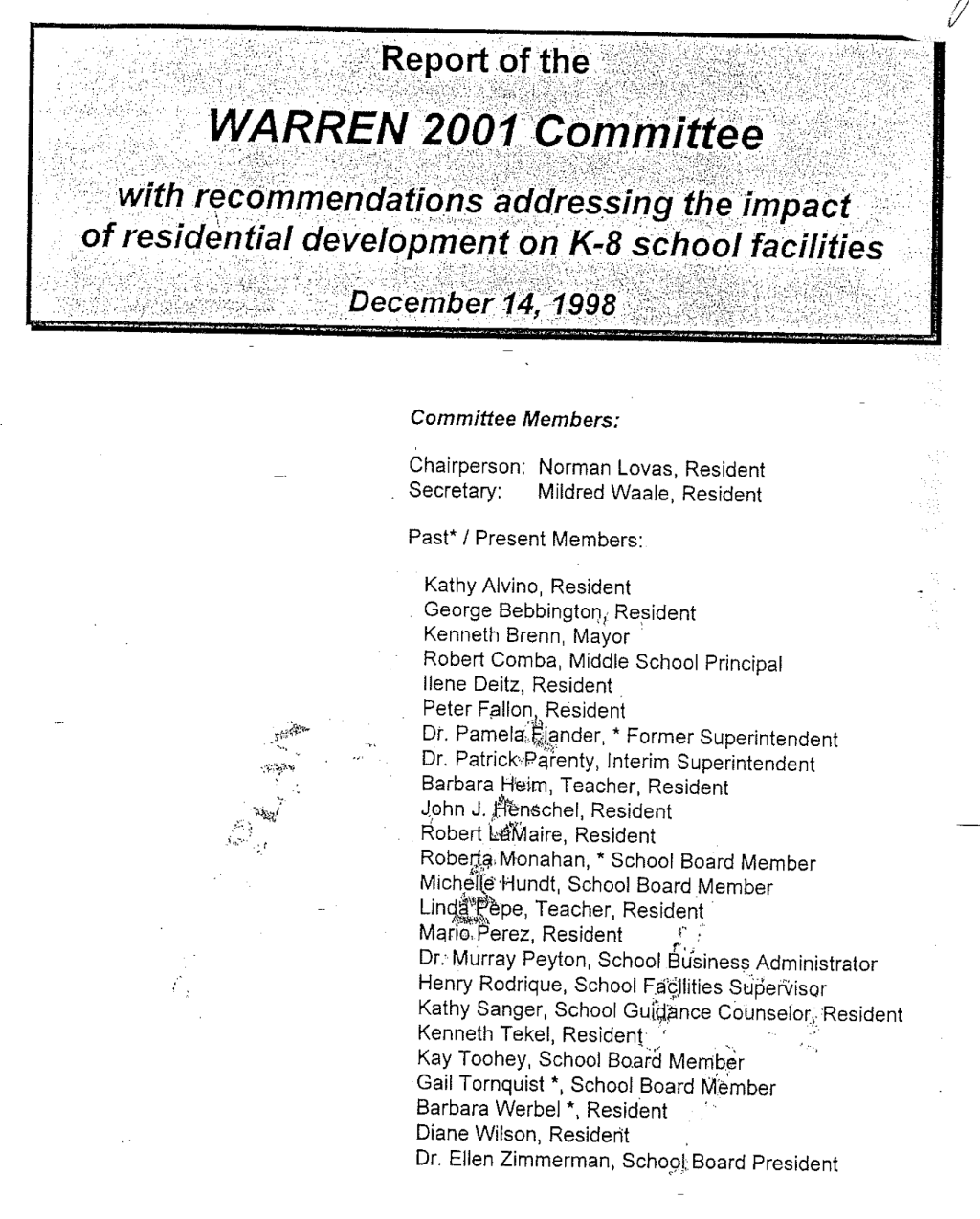
The Warren 2001 Committee—residents, staff, administrators, and local officials—spent nine months studying enrollment, programs, facilities, costs, and alternatives. It defined capacity broadly: class size, special education, small-group instruction, arts, technology, and future kindergarten all mattered. Its forecasts would continue rising as large kindergarten cohorts moved through the system.
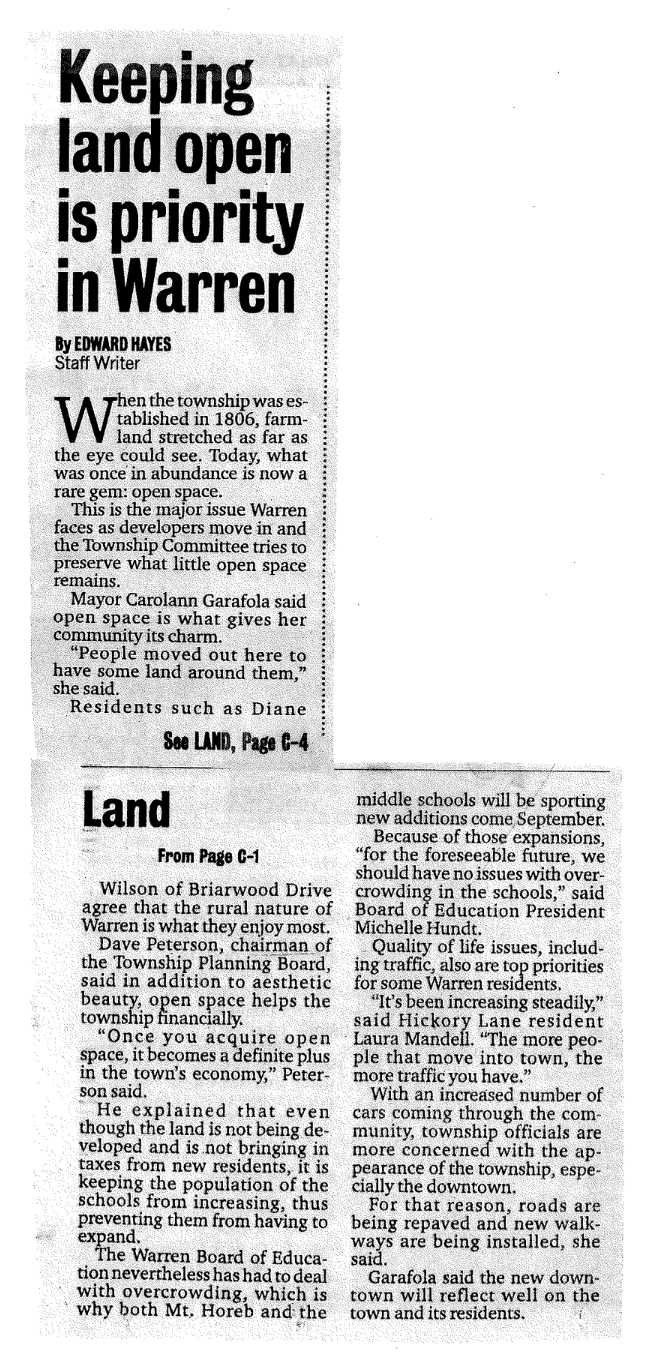
The committee anticipated 2,469 students by 2003–04, warned that Middle School capacity could be exceeded by 2001–02, and projected K–5 pressure soon after. Greenwood Meadows, expected to add 217 homes, was identified as a leading source of west-side growth. Growth was not merely an enrollment projection; it heightened concerns about traffic, taxes, open space, and Warren’s changing character.
The committee rejected doing nothing, building upward, sharing space, reducing programs, immediate reconfiguration, and a new fifth elementary school. Additions to existing schools were viewed as the least-cost near-term option, while the Township was urged to set aside 12 to 20 acres as a possible future school or open-space site. Reconfiguration was deferred because of substantial public opposition and because it did little to relieve the Middle School bottleneck through which every student would still pass.
Building for a Larger Warren
That work led to another referendum. On June 29, 1999, voters approved additions and renovations at Mt. Horeb and Warren Middle School, 862 to 564. Construction raised questions about wetlands, parking, traffic, athletic fields, and delayed occupancy. But the intent was clear: build for a larger Warren without sacrificing the programs residents expected.
Mt. Horeb was enlarged to a 460-student capacity and gained a gymnasium, reducing pressure on its all-purpose room. The 1999 referendum plan was designed to increase Middle School capacity from 700 to 900 students; subsequent construction ultimately brought the building to 1,000 students and added gym space.
Full-day kindergarten, introduced in 2001, required more than a curricular decision. Four former Woodland office rooms were converted to classrooms, and the Board reconsidered whether Mt. Horeb’s construction included enough kindergarten-ready space.
At the same time, program needs were changing. Planning treated technology, science, arts, world languages, guidance, special education, and small-group instruction as space needs—not extras. The district added elementary world-language instruction, developed a centralized English-language model, and joined neighboring districts in a demographic and capacity study. In 2001, it also concluded it lacked the space and community support for an in-district integrated preschool program, purchasing five county-program placements instead. Facilities planning was becoming inseparable from program planning.
The High-Water Mark
By 2002, Warren had reopened its closed schools, restored a four-elementary-school system, enlarged Mt. Horeb and the Middle School, and created space for a growing array of programs. Four years later, district enrollment reached 2,353 students—the highest point in Warren Township Schools history.
The journey from a proposed Central School closure to a historic enrollment peak took less than two decades. It was not a straight line. It involved failed referendums, contested grade configurations, competing projections, housing growth, construction problems, and persistent public debate.
But it also revealed something enduring about Warren. The community did not always agree quickly about what should be built, where students should attend, or how much growth to anticipate. It did, however, repeatedly return to the work of studying the problem, arguing through the alternatives, and making room for the children who arrived.
The new peak would not last forever. The system that had been rebuilt for growth would soon face another, quieter question: how to adapt when enrollment began to decline once more.
Community members with questions, feedback, or additional historical information are invited to contact the district at community@warrentboe.org.
Next installment: Part VII — After the Peak: Decline, Adaptation, and Reassessment (2007-2020)