
This article is part of an ongoing series exploring the history of the Warren Township School District. Each installment examines a distinct era in the district's development.
The Limits of Expansion
By the mid-1960s, Warren Township had done what it had set out to do in the postwar years: it had built schools - many of them. Woodland, Washington Valley, and Mt. Horeb had joined Central School in a growing network designed to accommodate a rapidly expanding population. Enrollment, however, continued to rise. By 1967, the district was serving more than 1,600 students, with projections suggesting that number could approach 2,000 within just a few years.
The problem was no longer simply one of space. It was one of organization.
Board minutes from the period reveal a system that, while expanded, was still improvised, with grades divided across buildings in ways that reflected capacity rather than design.
Instructional practices also reflected these constraints, with staff and students adapting to a system that had not yet fully defined how its parts should function together.
Central School, once the answer to Warren's educational needs, had become the district's primary pressure point.
The Push for a Middle School
As these pressures mounted, the Board's thinking began to shift. Earlier decisions had focused on where to build. Now, the question was how the system itself should be structured.
In October 1965, the Board articulated a long-range vision: five elementary schools serving kindergarten through fifth grade and two schools for grades six through eight. It was an ambitious model - one that anticipated continued growth and required a fundamentally different approach to organizing students and instruction.
At the same time, instructional concerns were becoming more visible, particularly around how well students were prepared for the transition to high school.
The middle school concept addressed both sets of challenges. It offered a way to relieve pressure on Central while also creating a more intentional environment for students in grades six through eight.
By 1967, the Board had taken a decisive step, securing land on Old Stirling Road for what would become the site of Warren Middle School. What followed, however, was not immediate approval. It was a process of community engagement, debate, and revision.
Failed Referendums and Community Negotiation
The development of Warren Middle School did not proceed without resistance. As with earlier building efforts in the township, it followed a familiar pattern: proposal, disagreement, and eventual compromise.
In 1969, the Board brought forward a plan for a new middle school costing just over $3.1 million.
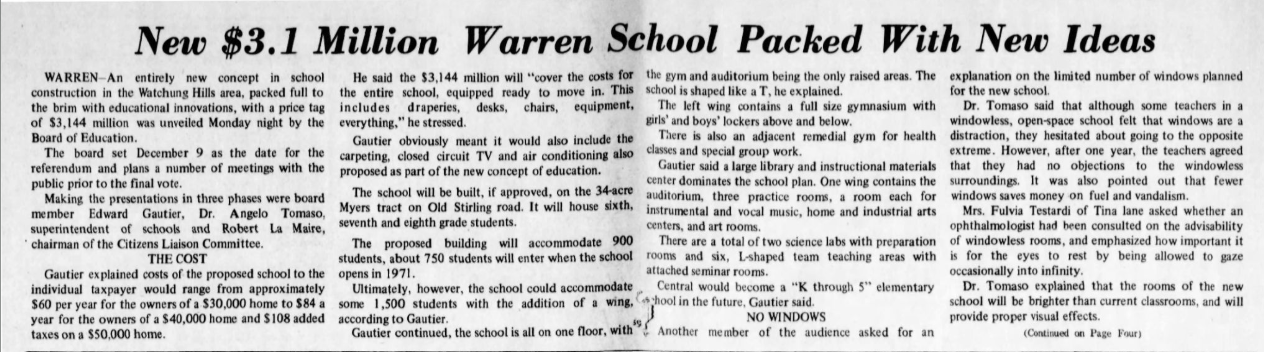
But those ideas - and the cost - gave some residents pause.
In the weeks leading up to the vote, public meetings drew strong attendance. Questions ranged from cost to design features, including whether certain elements were necessary. Misunderstandings circulated as well, including claims that the building would be windowless - an issue Board members addressed directly in public forums.
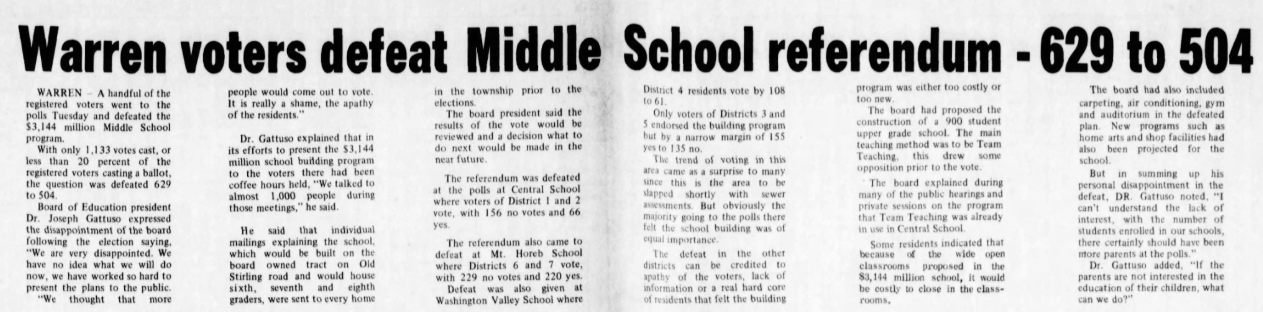
On December 9, 1969, voters rejected the proposal by a margin of 629 to 504.
The defeat was significant, but it did not end the conversation. Instead, it reshaped it.
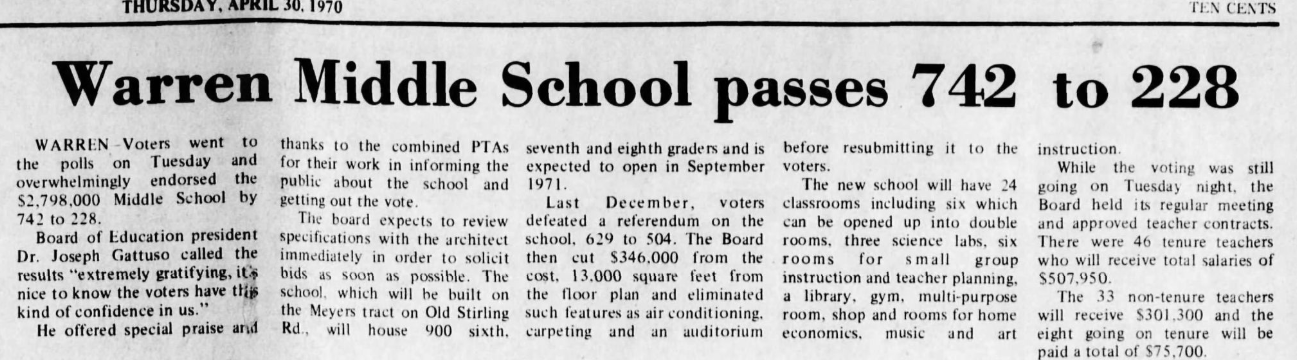
In the weeks that followed, Board members and community representatives worked closely to revise the plan. Input was actively solicited, and the Citizens' Liaison Committee remained deeply involved. The result was a streamlined proposal that reduced the overall cost by approximately $350,000. To achieve those savings, several high-profile features were removed, including full air conditioning and a planned auditorium.
The revised plan retained the core purpose of the school while responding directly to community concerns.
Just four months later, on April 28, 1970, voters approved the new referendum by a wide margin - 742 to 228.
The turnaround was striking. It reflected not only a revised proposal, but a community that had worked through its concerns and reached a shared understanding of what was needed.
Building Warren Middle School
With approval secured, the focus shifted from planning to execution. Construction began later in 1970, and over the next two years, the new middle school took shape on Old Stirling Road.
Board minutes reflect the practical realities of construction, including delays and coordination with local officials.
As the structure rose, it became clear that Warren was building something different.
When the school prepared to open in 1972, newspaper coverage highlighted its modern design and educational purpose. It also reflected the compromises made during the referendum process. The final design omitted features originally proposed, including air conditioning and a dedicated auditorium, but retained the core instructional vision that had driven the project.
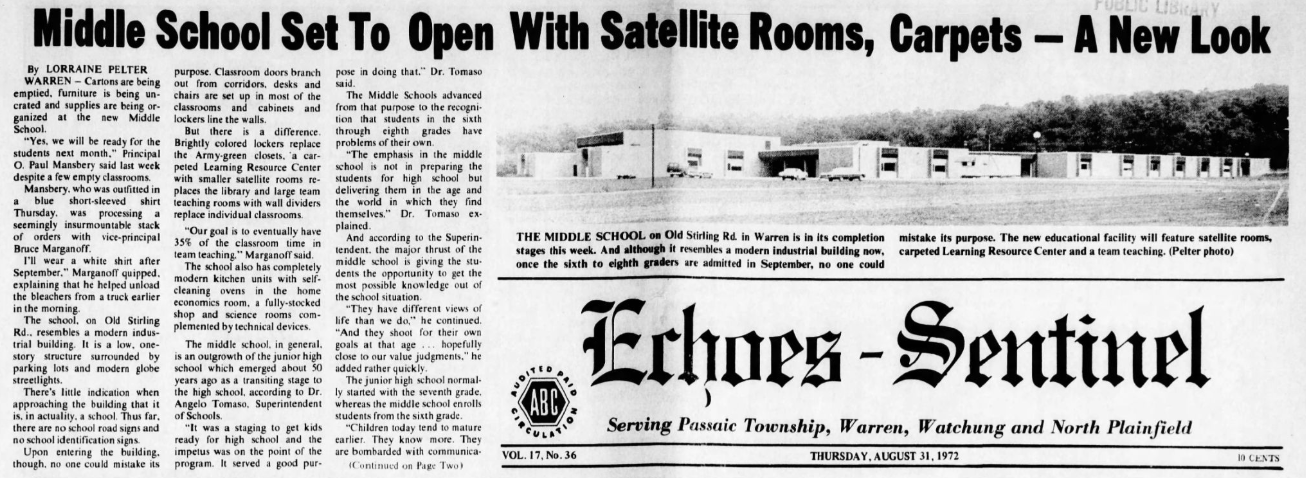
The school was designed to serve approximately 700 students in grades six through eight - bringing together, for the first time, all students at those grade levels in a single, purpose-built facility.
The opening of the middle school also coincided with a shift in the district's approach to special education. At the start of the 1970s, relatively few students were identified for such services, and many attended programs outside the district.
District leaders began taking early steps to serve more students in-district.
Reorganizing the District: The Modern Structure Emerges
The opening of Warren Middle School marked a turning point in the organization of the district.
For the first time, the system had a clear and intentional structure. Elementary schools served kindergarten through fifth grade. The middle school served grades six through eight. Students then moved on to Watchung Hills Regional High School.
This configuration, established in the early 1970s, remains recognizable today.
At the time of its opening, Superintendent Dr. Angelo L. Tomaso described the new school as a "flexible, modern facility that can change to meet the changes required of us in the next 50 years." The school facility and district organizational structure that emerged in the early 1970s was designed to meet the needs of the moment and proved durable enough to endure, even as changing conditions would prompt reconsideration.
The transition was not without adjustment. As the system took hold, community discussion shifted from where students were educated to how they were educated.
At the same time, the district expanded its programs. The middle school became not just a building, but a focal point for evolving expectations about education in Warren.
The Peak of Enrollment
The creation of Warren Middle School coincided with the district's peak period of growth.
Enrollment projections from the late 1960s had anticipated continued expansion. In the early 1970s, total district enrollment approached 2,000 students, representing the culmination of more than two decades of sustained growth.
The financial impact of the new structure was significant. Budget increases tied to the new structure placed pressure on taxpayers, and in 1973 voters rejected the proposed budget. Public discussion increasingly focused on cost and program priorities.
At the same time, enrollment growth began to level off.
A System Completed - and Tested
By the mid-1970s, Warren Township had achieved something it had been working toward for decades: a coherent, organized school system. Elementary schools fed into a dedicated middle school, which in turn prepared students for a regional high school. The structure was no longer improvised. It was designed.
But like all systems built to respond to a specific moment, it would not remain untouched.
Questions of space gave way to questions of program, cost, and expectations, and in time, changing enrollment patterns would once again force the community to reconsider how its schools were organized.
The creation of Warren Middle School marked the beginning of a new phase - one defined not by expansion, but by adaptation.
Community members with questions, feedback, or additional historical information are invited to contact the district at community@warrentboe.org.
Next installment: Part V - Enrollment Decline and Difficult Decisions (1976 - 1995)