
For more than two centuries, the story of public education in Warren Township has been inseparable from the story of the community itself. From early domestic instruction and small, locally run schools to today’s modern educational system, Warren’s schools have reflected the needs, values, tensions, and aspirations of the people who built and sustained them. What began as informal learning in homes and village settings gradually evolved into a network of one-room schoolhouses serving distinct sections of the township. As Warren changed, so too did its schools - sometimes incrementally, sometimes through moments of sharp public debate and decisive action.
Formal governance of education in Warren Township emerged gradually. While schooling existed earlier, records indicate that in 1847 the township replaced an informal committee structure with an elected Town Superintendent of Schools, reflecting a growing recognition of public education as a civic responsibility. By the late 19th century, Warren was organized into multiple school districts - Smalleytown, Dead River (later Mountain View), Warrenville, Springdale, and Independent - each operating its own small schoolhouse, typically with a single teacher instructing children of all ages. State reports from this period document modest funding, limited facilities, and wide variation in enrollment and attendance, conditions common in rural New Jersey at the time.
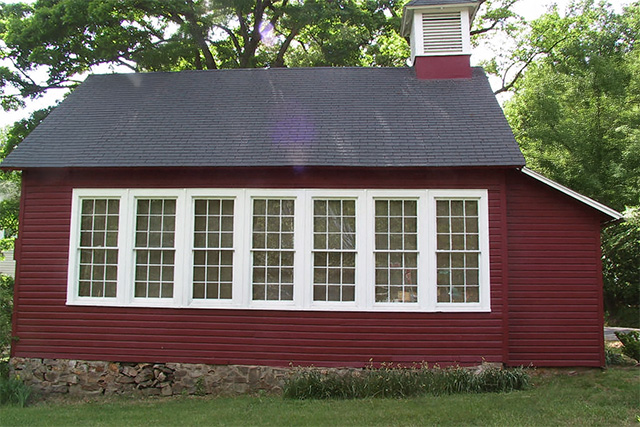
These early schools were more than instructional spaces. As recalled in later historical accounts, they functioned as community centers, hosting meetings, performances, and social gatherings, with families deeply connected to the daily life of each school. Several of these buildings still stand today as private residences, tangible reminders of a period when education in Warren was distinctly local and deeply personal.
By the early 20th century, however, the limitations of this decentralized system became increasingly apparent. Population growth, particularly in the years leading up to 1930, placed significant strain on facilities that were never designed for sustained expansion. Contemporary surveys documented overcrowded classrooms, inadequate sanitation, and unsafe conditions, prompting warnings from county and state officials that Warren risked losing state aid unless action was taken. After years of failed referendums and intense community disagreement, voters narrowly approved the construction of a centralized school in December 1931. Central School opened in 1933, replacing six smaller schoolhouses and marking a turning point in the township’s educational history.
The decades that followed reflected a recurring pattern that would define Warren Township Schools: demographic change followed by community debate and institutional response. Post-World War II growth drove the construction of Woodland School, Washington Valley School (now Angelo L. Tomaso School), Mt. Horeb School, and later the Middle School, while subsequent enrollment declines led to closures, leasing decisions, and renewed reassessment. Major infrastructure developments, including the opening of Interstate 78, again reshaped population trends and school capacity needs. Census and local records show Warren’s population rising from just over 1,000 residents in 1905 to more than 8,500 by 1970, and continuing to grow in later decades.
This series draws on a wide range of primary documents and local histories, including the work of Barbara Tomblin, Angela Ottobre, Susan Sie, Laurabell Goodwin, Janet B. Flint, and most especially Alan Siegel, whose diligent research has preserved much of what we know today. It also incorporates contemporaneous newspaper accounts, Board of Education records, state reports, and firsthand recollections that together provide a detailed and nuanced picture of how the township’s schools developed over time.
As the United States approaches its semiquincentennial in 2026, Warren Township once again finds itself in a familiar position - planning for growth while reflecting on lessons from the past. Guided today by a long-range Strategic Plan and informed by ongoing demographic study, the district faces questions that echo those debated by earlier generations: how to align facilities with enrollment, how to balance local identity with efficiency, and how to steward community resources responsibly for the benefit of future students.
This eight-part series traces the development of the Warren Township School System from its earliest origins to the present day. Each installment stands on its own, but together they tell a story of persistence, adaptation, and civic engagement. By revisiting this history with care and clarity, the series aims to preserve a shared record of the past while offering perspective for the decisions still ahead.
The district extends special thanks to Rory Britt of the Warren Township Historical Society for reviewing and offering feedback on an early draft of this project and to Darryl Voorhees and Nicole Poyer of the Warren Township branch of the Somerset County Library System for their research assistance.
Community members with questions, feedback, or additional historical information are invited to contact the district at community@warrentboe.org.
Next installment: I. The Foundation Era: From Dame Schools to District Schools (c. 1700s – 1930)